
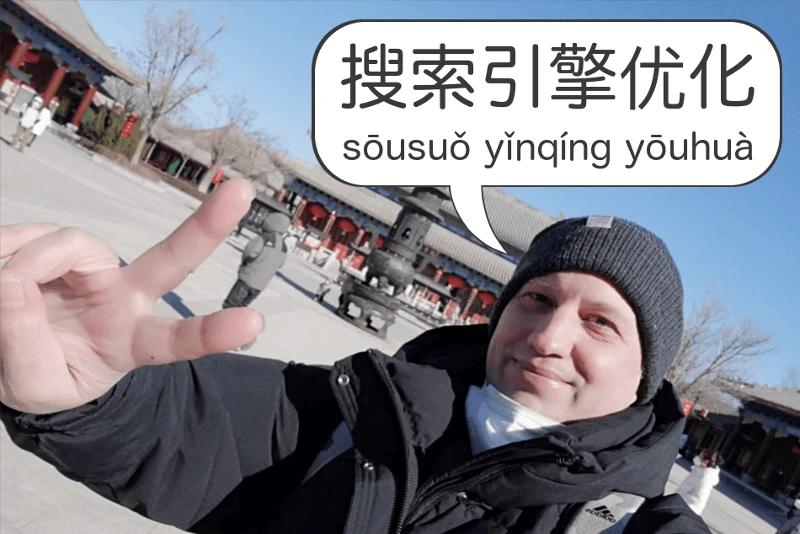
Mandarin Chinese for Marketers: Essential SEO & SEA Vocabulary with Pinyin & Context Examples
Complete Chinese vocabulary guide for online marketing professionals — covers search engine optimization, search engine advertising, Baidu, keywords, rankings, and practical office phrases with pinyin and contextual examples
Working in China's digital marketing landscape without Mandarin creates communication barriers — especially with SEO specialists and developers who may lack English confidence. Marcus Pentzek, Director of SEO at Jademond Digital, compiled this comprehensive vocabulary guide after observing how speaking even basic Mandarin transforms workplace collaboration.
This guide covers essential marketing terms (搜索引擎 = search engine, 网络营销 = internet marketing), SEO-specific vocabulary (搜索引擎优化 = SEO, 自然排名 = organic ranking, 反向链接 = backlinks), and SEA concepts (搜索引擎广告 = search advertising, 点击率 = click-through rate). Each term includes pinyin and contextual example sentences — designed for non-native speakers working daily with Chinese colleagues, Baidu specialists, or China-focused marketing teams. Speaking Mandarin marketing terminology builds trust and accelerates knowledge transfer in a way English simply cannot.
The importance of speaking Mandarin in China
I recently joined Jademond Digital as the only foreigner working among Chinese. Our founder and CEO speak fluent English, just like all my colleagues that as working as account managers. Those people have direct contact with our often foreign customers. But those SEO specialists – the magicians working with the magic keywords and crafting title spells to help our client’s websites rank better – and almost all the other colleagues often have very little English skills – or haven’t practiced in a long time, so they have little self-confidence speaking.
A short anecdote from my office life in Guangzhou
The other day, when I walked through the office, the laptop in my hand, approaching our developer Bailin (a Mandarin-only speaker), the first thing he did was turn his back on me, trying to avoid speaking with the foreigner.
But when I sat down next to him, put the laptop on the table, and said “你好。这个code有问题,可是我不知道为神马有问题。你可以帮我吗。你可以看看嘛?” he instantly turned around, looked at my computer and answered me in Chinese. There was no embarrassment anymore – except by me because I only understood half of what he said.
But with the few words, I could understand, plus some typing within my python code on the computer, I was able to understand his idea. And I could see his friendly face. Speaking some Mandarin helps to connect with people. And knowing some key phrases related to your job helps to exchange ideas.
Purpose of this blog post
The reason for this blog post is not so much to help you out there, but much more a reminder for myself. I will keep adding to this post with new Chinese vocabulary and new short phrases to use in my daily office life. The fact that the post could also help others was then only the final tipping point to make it public, instead of as a pure excel spreadsheet on my computer.
Mandarin Vocabulary
Basic Online Marketing vocabs
| English | Chinese | Pinyin |
|---|---|---|
| internet | 互联网 | hùliánwǎng |
| internet marketing | 网络营销 | wǎngluò yíngxiāo |
| online marketing | 网络营销 | wǎngluò yíngxiāo |
| website | 网站 | wǎngzhàn |
| traffic | 交通 | jiāotōng |
| customers | 客户 | kèhù |
| social media | 社交媒体 | shèjiāo méitǐ |
| brand | 品牌 | pǐnpái |
| brand awareness | 品牌意识 | pǐnpái yìshí |
Some basic Mandarin internet-related vocabulary (translations checked by my colleague Kammy)
Using these words in context:
我利用互联网进行营销。
Wǒ lìyòng hùliánwǎng jìnxíng yíngxiāo.
I use the internet for marketing.
我利用网络营销来提高品牌知名度。
Wǒ lìyòng wǎngluò yíngxiāo lái tígāo pǐnpái zhīmíngdù.
I am using internet marketing to raise brand awareness.
我从事网络营销工作。
Wǒ cóngshì wǎngluò yíngxiāo gōngzuò.
I work in online marketing.
我帮助我的客户的网站获得更多流量。
Wǒ bāngzhù wǒ de kèhù de wǎngzhàn huòdé gèng duō liúliàng.
I help my customer’s websites get more traffic.
社交媒体是网络营销的一个非常重要的部分。
Shèjiāo méitǐ shì wǎngluò yíngxiāo de yīgè fēicháng zhòngyào de bùfèn.
Social media is a very important part of online marketing.
SEO & SEA vocabs
| English | Chinese | Pinyin |
|---|---|---|
| search engine | 搜索引擎 | sōusuǒ yǐnqíng |
| 谷歌 | gǔgē | |
| Baidu | 百度 | bǎidù |
| search engine marketing | 搜索引擎营销 | sōusuǒ yǐnqíng yíngxiāo |
| search engine advertising (SEA) | 搜索引擎广告 | sōusuǒ yǐnqíng guǎnggào |
| search engine optimization (SEO) | 搜索引擎优化 | sōusuǒ yǐnqíng yōuhuà |
| keyword | 关键字 | guānjiàn zì |
| keyword phrase | 关键字短语 | guānjiàn zì duǎnyǔ |
| short head keyword | 短标题关键词 | duǎn biāotí guānjiàn cí |
| long tail keyword | 长尾关键词 | cháng wěi guānjiàn cí |
| search intent | 搜索意图 | sōusuǒ yìtú |
| search results page (SERP) | 搜索结果页面 | sōusuǒ jiéguǒ yèmiàn |
| search results | 搜索结果 | sōusuǒ jiéguǒ |
| organic search results | 自然搜索结果 | zìrán sōusuǒ jiéguǒ |
| organic ranking | 自然排名 | zìrán páimíng |
| paid search results (search ads) | 付费搜索结果 | fùfèi sōusuǒ jiéguǒ |
| (search result) snippet | 片段 | piànduàn |
| title line (of a search result snippet or an ad) | 标题行 | biāotí xíng |
| description (of a search result snippet or an ad) | 描述 | miáoshù |
| title tag (of the web page) | 标题标签 | biāotí biāoqiān |
| meta description | 元描述 | yuán miáoshù |
| meta keywords | 元关键词 | yuán guānjiàn cí |
| body text | 主体文字 | zhǔtǐ wénzì |
| headlines | 头条新闻 | tóutiáo xīnwén |
| h1 headline | h1标题 | h1 biāotí |
| images | 图像 | túxiàng |
| image alt tag | 图片alt标签 | túpiàn alt biāoqiān |
| quality score (in Google SEA) | 质量得分 | zhì liáng défēn |
| to search (online) | 搜索 | sōusuǒ |
| B2B | B2B | B2B |
| B2B business | B2B业务 | B2B yèwù |
| Baidu owned results | 百度自有结果 | bǎidù zì yǒu jiéguǒ |
| click through rate (CTR) | 点击率 | diǎn jí lǜ |
| ranking factor | 排名因素 | páimíng yīnsù |
| to optimize | 来优化 | lái yōuhuà |
| onpage | 网页上 | wǎngyè shàng |
| onsite | 现场 | xiànchǎng |
| offpage | 网页外 | wǎngyè wài |
| backlink | 反向链接 | fǎn xiàng liànjiē |
SEO & SEA related Mandarin vocabulary (translations checked by my colleague Kammy)
Using SEA words in context:
搜索引擎营销对B2B企业尤其重要。
Sōusuǒ yǐnqíng yíngxiāo duì B2B qǐyè yóuqí zhòngyào.
Search engine marketing is especially important for B2B businesses.
搜索引擎广告(SEA)是购买搜索结果。
Sōusuǒ yǐnqíng guǎnggào (SEA) shì gòumǎi sōusuǒ jiéguǒ.
Search engine advertising (SEA) is buying search results.
SEA是关于付费搜索结果(搜索广告)。
SEA shì guānyú fùfèi sōusuǒ jiéguǒ (sōusuǒ guǎnggào).
SEA is about paid search results (search ads).
在SEO和SEA中,我们都需要优化我们的片段。
Zài SEO hé SEA zhōng, wǒmen dōu xūyào yōuhuà wǒmen de piànduàn.
In both, SEO and SEA we need to optimize our snippets.
对于SEA来说,质量得分也是一个Onpage话题。
Duìyú SEA lái shuō, zhì liáng défēn yěshì yīgè Onpage huàtí.
For SEA the quality score also is an On-page topic.
Using SEO words in context:
如果我搜索英文内容,我会使用谷歌。
Rúguǒ wǒ sōusuǒ yīngwén nèiróng, wǒ huì shǐyòng gǔgē.
If I search for English content I use Google.
如果我搜索中文内容,我会使用百度。
Rúguǒ wǒ sōusuǒ zhōngwén nèiróng, wǒ huì shǐyòng bǎidù.
If I search for Chinese content I use Baidu.
搜索引擎优化(SEO)需要时间来发挥效果。
Sōusuǒ yǐnqíng yōuhuà (SEO) xūyào shíjiān lái fā huī xiào guǒ.
Search engine optimization (SEO) needs time to show success.
网站应该有一个关键词的排名。
Wǎngzhàn yīnggāi yǒu yīgè guānjiàn cí de páimíng.
The website is supposed to rank for a keyword.
通常它不是一个单一的关键词,而是一个关键词短语。
Tōngcháng tā bùshì yīgè dānyī de guānjiàn cí, ér shì yīgè guānjiàn cí duǎnyǔ.
Often it is not a single keyword, but rather a keyword phrase.
要在短标题的关键词上获得排名真的很难–往往是不可能的。
Yào zài duǎn biāotí de guānjiàn cí shàng huòdé páimíng zhēn de hěn nán–wǎngwǎng shì bù kěnéng de.
To rank for short-head keywords is really hard – often impossible.
百度的自有产品往往有排名。
Bǎidù yǒngyǒu de jiéguǒ wǎngwǎng páimíng.
Baidu-owned results often ranks.
要想让一个网站获得长尾关键词的排名是比较现实的。
yào xiǎng ràng yīgè wǎngzhàn huòdé cháng wěi guānjiàn cí de páimíng shì bǐjiào xiànshí de.
To rank a website for long tail keywords is more realistic.
重要的是你网站的关键词能够匹配搜索意图。
Zhòngyào de shì nǐwǎngzhàn de guānjiàn cí nénggòu pǐpèi sōusuǒ yìtú.
It is important to choose keywords with the search intent your website can serve.
将关键词交给百度后,它会显示搜索结果页(SERP)。
Jiāng guānjiàn cí jiāo gěi bǎidù hòu, tā huì xiǎnshì sōusuǒ jiéguǒ yè (SERP).
After giving the keyword to Baidu it shows the search results page (SERP).
搜索结果相当混杂。
Sōusuǒ jiéguǒ xiāngdāng hùnzá.
The search results are quite mixed.
最近,SERP内的自然搜索结果较少。
Zuìjìn,SERP nèi de zìrán sōusuǒ jiéguǒ jiào shǎo.
There are fewer organic search results within a SERP lately.
SEO是关于自然排名,而不是付费。
SEO shì guānyú zìrán páimíng, ér bùshì fùfèi.
SEO is about organic ranking, not paid.
尽管仍有一些人表示,你不能为自然排名付费。
Jìnguǎn réng yǒu yīxiē rén biǎoshì ,nǐ bùnéng wéi zìrán páimíng fùfèi.
You can not pay for organic ranking space, although still some people say that.
对于相关性来说,最重要的是标题行。
Duìyú xiāngguān xìng lái shuō, zuì zhòngyào de shì biāotí xíng.
The most important for relevance is the title line.
为了获得更高的点击率(CTR),要优化描述。
Wèile huòdé gèng gāo de diǎn jí lǜ (CTR), yào yōuhuà miáoshù.
To optimize for a higher click-through rate (CTR), optimize the description.
在SEO中,优化(网页的)标题标签很重要。
Zài SEO zhōng, yōuhuà (wǎngyè de) biāotí biāoqiān hěn zhòngyào.
In SEO is important to optimize the title tag (of the web page).
元描述不是直接的排名因素,而是一个间接的排名因素。
Yuán miáoshù bùshì zhíjiē de páimíng yīnsù, ér shì yīgè jiànjiē de páimíng yīnsù.
The meta description is no direct ranking factor, but an indirect one.
元关键词不是一个排名因素,尽管很多人仍然相信它。
Yuán guānjiàn cí bùshì yīgè páimíng yīnsù, jǐnguǎn hěnduō rén réngrán xiāngxìn tā.
The meta keywords are not a ranking factor, although many people still believe it.
主体文字需要特殊的SEO处理来获得优化。
Zhǔtǐ wénzì xūyào tèshū de SEO chǔlǐ lái huòdé yōuhuà.
The body text needs special SEO treatment to get optimized.
在SEO中,有一些标题需要特别处理。
Zài SEO zhōng, yǒu yīxiē biāotí xūyào tèbié chǔlǐ.
Headlines also need special treatment in SEO.
最重要的头条是h1头条。
Zuì zhòngyào de tóutiáo shì h1 tóutiáo.
The most important headline is the h1 headline.
图片也可以被优化。
Túpiàn yě kěyǐ bèi yōuhuà.
Images as well can be optimized.
一个方面是图片的alt标签,它应该包含关键词。
Yīgè fāngmiàn shì túpiàn de alt biāoqiān, tā yīnggāi bāohán guānjiàn cí.
One aspect is the image alt tag, which should contain the keyword.
Onpage是指在一个页面内可以优化的一切。
Onpage shì zhǐ zài yīgè yèmiàn nèi kěyǐ yōuhuà de yīqiè.
Onpage means everything that can be optimized within a page.
Onsite是指对许多页面有影响的一切。
Onsite shì zhǐ duì xǔduō yèmiàn yǒu yǐngxiǎng de yīqiè.
Onsite means everything that has an influence on many pages.
Offpage指的是不在你的网站上发生的一切。
Offpage zhǐ de shì bùzài nǐ de wǎngzhàn shàng fāshēng de yīqiè.
Offpage means everything that is not happening on your website.
SEO中一个重要的非页面元素是反向链接。
SEO zhōng yīgè zhòngyào de fēi yèmiàn yuánsù shì fǎn xiàng liànjiē.
An important off-page element in SEO are backlinks.